
Faisalabad orders every shop to install CCTV — a step toward proactive public safety
View original post on LinkedIn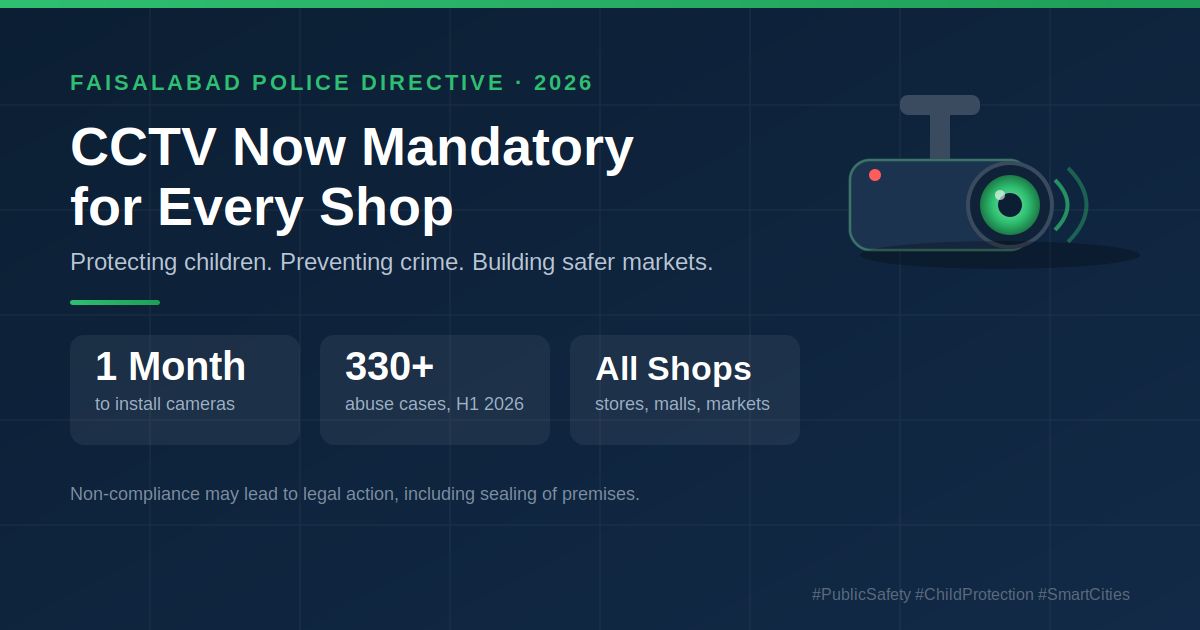
In July 2026 Faisalabad Police ordered every shop, market and mall in the district to install CCTV within one month or face legal action, including sealing. The mandate is a real step toward proactive public safety, but cameras alone only record. Camsense, a 24/7 surveillance AI agent, argues the next step is making sure someone, or something, is actually watching.
What exactly did Faisalabad Police order?
Every commercial outlet in Faisalabad must have working CCTV within one month. City Police Officer Tanveer Hussain issued the directive, which covers shops, departmental stores, wholesale markets, shopping malls and other commercial establishments across the district, from the smallest grocery store upward. Shopkeepers who do not comply face legal action that can include registration of criminal cases and sealing of their premises. The state news agency APP reported that a monitoring campaign would follow the deadline to check that cameras are installed and functional.
The order was not issued in a vacuum. According to official figures reported at the time, 330 cases involving the sexual abuse of minor boys and girls were reported across Faisalabad district between 1 January and 30 June 2026. Alongside child protection, the police named curbing theft, robbery and harassment, and strengthening digital evidence for investigations, as aims of the directive.
Why does a CCTV mandate matter for public safety?
Because visible, universal coverage changes behaviour and changes what can be proven. A mandate that reaches every shop, rather than a few large stores, closes the gaps between cameras that offenders rely on. Three effects are worth naming:
- Deterrence. Cameras that are visibly present across a whole market change behaviour before an incident happens. That is proactive safety, not only after-the-fact investigation.
- Evidence. Digital footage gives investigators something concrete to work with, which matters most in cases where a child's account would otherwise stand alone.
- Shared accountability. Shopkeepers, customers and children moving through busy bazaars all benefit when accountability is built into the physical space instead of left to chance.
Is installing cameras enough on its own?
No. A camera that nobody watches records the incident; it does not interrupt it. Most shop systems write footage to a recorder in a back room and keep it for a few weeks. Someone looks at it only after a complaint, which means the footage helps explain what happened but rarely changes the outcome. We have written about this gap before: footage nobody reviews isn't security, it's storage.
The arithmetic is the problem. A single market can have hundreds of new cameras by the end of a mandate like this, and no shopkeeper can watch his own feeds while serving customers. Police control rooms cannot watch every private feed in a district either. Coverage scales with every camera installed; human attention does not.
How does AI monitoring turn passive cameras into active protection?
It watches every feed continuously and raises an alert the moment something needs a human decision. Instead of hours of recordings that nobody opens, an AI monitoring layer reads the live streams, recognises defined events such as entry into a restricted area or unusual activity after hours, and sends a short, timestamped alert to the person responsible. People then review a handful of flagged moments rather than scrubbing whole days of footage.
For shopkeepers complying with the Faisalabad order, the practical point is that the cameras they are buying now do not need to be replaced later. Camsense connects to the CCTV a business already owns, including any RTSP-capable camera from brands such as Hikvision and Dahua. The technical reason that works is explained in what RTSP actually means, and the step-by-step setup is on how it works.
Every detection is also logged with timestamped video, so the audit trail builds itself. For a shop, that means evidence is ready when the police ask for it, rather than reconstructed from a recorder after the fact.
What safeguards should come with mass CCTV?
Clear purpose, controlled access and defined retention. Surveillance that protects children has to be deployed with the same care for everyone else who walks past the lens. Any business or city adding cameras at this scale should be able to answer three questions plainly:
- What is it for? Monitoring should be tied to stated public-safety and business purposes, such as preventing abuse, theft and robbery, not open-ended observation.
- Who can see it? Access to live feeds and recordings should be limited to the people who need it, with a record of who viewed what.
- How long is it kept? Retention should be a deliberate choice, not whatever the recorder's hard disk happens to hold.
At Camsense, footage is retained for as long as the customer chooses; when the customer deletes it, Camsense deletes it. Data is used internally only to improve Camsense's detection models. That kind of plain answer is what turns a surveillance network from something people tolerate into something they trust.
What should Faisalabad businesses do next?
Comply first, then make the cameras useful. Install working cameras that cover entrances, counters and storage, confirm they record reliably, and check that they can stream to a network so they are not a dead end. Once the mandate is met, the question for larger retailers, wholesalers and malls becomes whether anyone is watching the feeds in time to matter. A free surveillance audit is a no-commitment way to find out what an existing setup can already support.
Credit to CPO Tanveer Hussain and Faisalabad Police for a firm, decisive stance. The open question for everyone working in public-safety technology is how to make sure infrastructure like this is paired with the right privacy safeguards, and actually delivers on its promise.
Frequently asked questions
What does the Faisalabad CCTV order require?
Faisalabad Police directed all shops, departmental stores, wholesale markets, malls and other commercial outlets in the district to install working CCTV within one month. Non-compliance can lead to legal action, including criminal cases and sealing of premises.
Why did Faisalabad Police make CCTV mandatory for shops?
The directive followed official figures showing 330 reported cases of child sexual abuse in the district in the first six months of 2026. Police also cited curbing theft, robbery and harassment, and improving digital evidence for investigations.
Can AI monitoring use the cameras shops are installing now?
Yes, if they stream over a network. Camsense connects to existing RTSP-capable cameras, including Hikvision and Dahua, so shops do not need to replace the hardware they bought to comply with the order.
How does Camsense handle footage?
Footage is retained for as long as the customer chooses. When the customer deletes it, Camsense deletes it. Data is used internally only to improve Camsense's detection models.
Sources
Related reading
See what your cameras are missing
Get a Free Surveillance Audit — a four-pillar findings report on a sample of your existing feeds. No new hardware, no obligation.
Get a Free Surveillance Audit